Showing posts with label Carl Phillips. Show all posts

Tuesday, September 18, 2012

Photo Gallery: September 17, 2012, Washington, D.C.

the hottest ticket in town
(photo credit: Eduardo C. Corral)
the stage
(photo credit: Dan Vera)
the audience
Eduardo at the Folger's new podium (1)
(photo credit: Dan Vera)
Eduardo at the Folger's new podium (2)
(photo credit: Dan Vera)
Carl at the podium
(photo credit: Dan Vera)
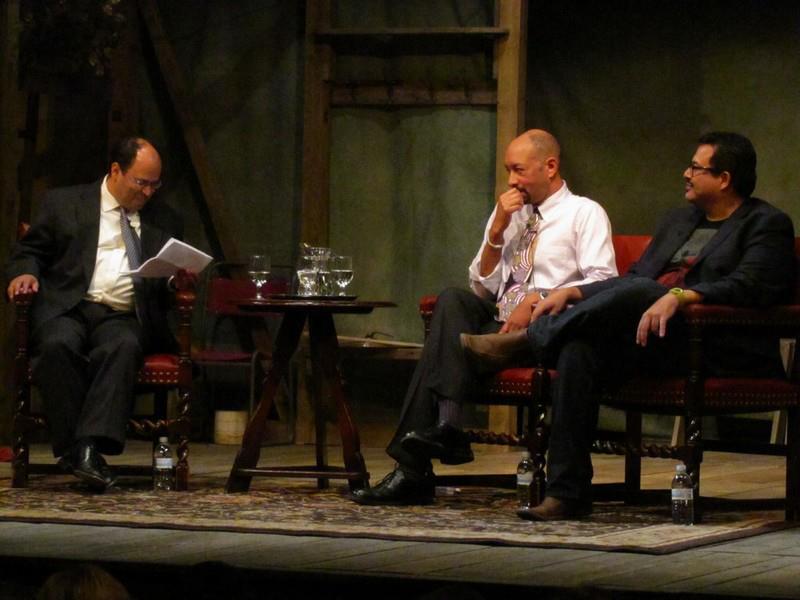
post-reading discussion using poets'
statements as springboards
(photo credit: Dan Vera)
Eduardo responding
(photo credit: Dan Vera)
Eduardo's excerpted statement:
"Spanish and poems come to me in pieces: the flash of a phrase, a jumble
of syntaxes and dictions, verbal hurdles, the pursuit of epiphany and meaning.
But something magical happens when I'm writing a poem. I'm not singing
in English or Spanish---I'm singing in my mother tongue"
Carl responding
(photo credit: Dan Vera)
Carl's excerpted statement:
"I think of syntax as being related to the erotic. In syntax,
embedded clauses and subordination are the equivalent of
sexual stalling. It's like foreplay."
view from the seats
(photo credit: Sandra Beasley)

*
Letras Latinas programming
in Washington, D.C.
is made possible
thanks to the generosity
of the Weissberg Foundation
and individual donors.

Saturday, September 15, 2012

"Letras Latinas Presents:" 2 Readings


“Letras Latinas Presents” is, as was written here, “one-off partnerships with literary allies around the country,” which when taken as whole, as a collective of events represents Letras Latinas’ roster of events for the 2012/2013 “season.”

Fred Arroyo and Richard Blanco are set to kick off “Letras Latinas Presents” with a joint reading tomorrowCo-sponsored with the Bernardin Haskell Funds, UMKC Dept. of Latina/Latino Studies/UMKC Dept. of Foreign Languages and Literatures, The Latino Writers Collective, Riverfront Reading Series, The Writers Place—at the Riverfront Reading Series at The Writer’s Place in Kansas City, Missouri.

Poet Richard Blanco’s most recent collection is Looking for the Gulf Motel (University of Pittsburg Press, 2012) and which was recently profiled in The Poetry Society of America’s series of interviews: Red, White and Blue: Poets on Politics. An interview in which Richard Blanco discusses his experience as a young Cuban-American and queer man growing up in the hyper-politicized world of Miami, and his navigation of geopolitics in order to land at a place where he may, as a poet,  "show" the consequences of politics through portraits of people and places. And which interestingly enough is also a topic that is poignantly touched on by Richard Blanco in this Letras Latinas Oral History Project interview, where he chronicles his parents journey of exile from Cuba to Madrid, where he was born, and eventually to Miami, Florida where Blanco grew up as (and this is no metaphor) a “citizen of no country.” And of his search for—through writing—for a “place in the imagination” that can replace the “mythic homeland” which—for those who have experience exile or migration—has in a very physical sense seized to exist.

Fred Arroyo is the author of two collections: The Region of Lost Names (University of Arizona Press, 2008) and the most recent Western Avenue and Other Fictions (University of Arizona Press, 2012). In this interview for Letras Latina’s Oral History Project, Arroyo speaks of his fascination with the “submerged populations” of Michicana—immigrants living in the Midwestern U.S. (in southwestern Michigan and northwester Indiana, a place of “border existences”) and struggling against an industrial and agricultural world that thrives on their anonymity. Behind Fred Arroyo’s writing is the search for a community “founded on loss” but also on memory, which makes his characters resilient as the bark on tress. Fred Arroyo will also be reading at the campus of the Notre Dame on October 4th, reading from his collection of short stories Western Avenue and Other Fictions.

*

Eduardo C. Corral  and Carl Phillips @ The Folger Shakespeare Library

In this interview for the Letras Latinas Blog, Eduardo C. Corral recalls how he found out his manuscript, Slow Lightning, had been selected winner of the Yale Series of Younger Poets Prize: “A voice said, Hello Eduardo Corral this is Carl Phillips….” That voice however was only one of three voicemails left by Carl Phillips. And Eduardo was thus left anxiously waiting for Philips to return his call:

“Then my cell phone rang.  I walked over to the piano, rested my elbows on it, and answered.  After we exchanged a few pleasantries, Carl Phillips asked, Is your manuscript still available for publication?  I said, Yes.  Then he said, Good, because I've just selected it for the Yale Series of Younger Poets.  I honestly don't remember much of the conversation after he said that.  But I do remember three things.  I thanked him.  I asked him to repeat the news.  I quietly sobbed while he said amazing things about my poems.”

In another interview with Eduardo, Michael Klein has this to say of Slow Lightning: “It’s a great book: inventive, lyrical, hypnotic and magically realistic.” What I particularly appreciate in Eduardo C. Corral’s work is his steadfast commitment to poetry, to the poet’s craft.  In explaining Robert Hayden’s influence on his work Corral writes, “he taught me the supreme importance of craft. He also taught me a poet of color doesn’t need to explain his art to anyone – not even to his community. This realization was a breakthrough for me: it freed me from worrying if I was too Latino or not Latino enough. It freed me to write the poems I needed to write.”

Corral for me picks up on what I perceive to be one of two axioms of poetry: the only topic of poetry is poetry. Poetry when written correctly does not seize to be poetry despite what she is forced to sing about. And the other axiom being that all poems once written are dead poems—dead in the sense that the life and joy of a poem occurs during—what Corrals refers to as the “drafting” or “sculpting” of a poem—the birthing of a poem:

“That said: the shape [of the poem] rarely comes with the raw material. A shape usually announces itself near the end of the drafting process. When I start sculpting a poem, I know it’s close to completion.”


Thursday, August 19, 2010

City of Asylum Pittsburgh/Sampsonia Way

One of the highlights (among many) of this summer was the week I spent on Sampsonia Way in Pittsburgh, PA at the invitation of City of Asylum/Pittsburgh--one of the most inspiring literary organizations I've had the pleasure of being involved with. When Henry Reese, the founder and Executive Director, learned that Brenda Cárdenas and I were going to be week-long guests at the Cave Canem retreat at the University of Pittsburgh in Greensburg, he generously invited us to a one-week residency in the week after the Cave Canem gathering and offered to organize a reading for us. During the time we were there, housed in one of City of Asylum's homes, we were interviewed by City of Asylum's literary companion Sampsonia Way. Sampsonia Way also recently interviewed Carl Phillips, who was on the faculty at Cave Canem. Below are the links to Brenda's and Carl's interviews which, in a way, I view as companion pieces.


Brenda Cárdenas reading outside of House Poem on Sampsonia Way, 
Photo © Renee Rosensteel


Carl Phillips on Sampsonia Way
Photo by Renee Rosensteel


*


Sampsonia Way is an online magazine sponsored by City of Asylum/Pittsburgh celebrating literary free expression and supporting persecuted poets and novelists worldwide.