Showing posts with label Vickie Vértiz. Show all posts

Wednesday, December 21, 2016

Our Warrior: A Celebration of Rigoberto González

Rigoberto González @ Poet's House
December 6, 2016

Among the NYC poetry orgs Letras Latinas has had the pleasure of collaborating with, Poet’s House holds a place of honor: in the Fall of 2009, they hosted the fourth final stop of, “The Wind Shifts Tour,” which consisted of a reading featuring four contributors of The Wind Shifts anthology, as well as a pre-reading panel discussion on Latino/a poetics, featuring NYC-based Latino/a poets. So when Poet’s House, this time around, approached Letras Latinas about co-presenting an event to celebrate Rigoberto González’s contributions to our field, it was easy to say Yes. What follows is an account of that special evening. Special thanks to Nathan Xavier Osorio for contributing this piece. FA

Our Warrior: A Celebration of Rigoberto González


On Tuesday, December 6th, Natalie Diaz and Ada Limón co-hosted a celebration of Rigoberto González in Downtown Manhattan’s Poet’s House. Despite the early winter rain, the venue felt true to its name – homelike.  It vibrated with old friends reuniting and shuffling along the packed room in search of a place to sit or stand. La raza cósmica had shown up to honor a poet who, throughout his career –which includes four books of poetry, ten books of prose, and the Bill Whitehead Award for Lifetime Achievement– had never forgotten about us. In their opening speech, Limón and Diaz called him, “Our Warrior … a man who had written for us, of us.” Limón praised the beauty of his language saying, “his poems are lessons on bowing down to sound and confronting the abyss.” Rigoberto González sat in the first row, wearing a suit and a dark blue sarape that hung down his right shoulder like the fashionable champion he had come to be known as. Diaz described how the after-cocktail ritual of remembering friends and heroes would often end with González’s name and his message that poetry is service and the light by which we navigate the borderlands of our identity.  
Ada Limón, Natalie Diaz, Rigoberto González

The evenings readers shared their own stories of González and selections of his work. They came from local barrios like Brooklyn’s Bushwick, and further out west from Ann Arbor, Michigan, and Bell Gardens, California, demonstrating the vitality of the community González has influenced.  Saeed Jones, the author of Prelude to a Bruise, a finalist for the 2014 National Book Critics Circle Award and former student of González at Rutgers University – Newark, read first. Jones reflected on how Rigoberto was his first non-straight, non-white literature teacher and how he guided him to understand that in our writing, “sentimentality is not humanizing, clarity is.” Jones’ reading of González’s persona poem “Gila,” with its line, “I make a throne of the body/ until it begins to decay.” reminds us of how devotion to clarity can animate the spirit embedded in language.


 Saeed Jones
 Elisabet Velásquez

Elisabet Velásquez, a spoken-word poet who has performed at the Brooklyn Museum, Lincoln Center Out of Doors and the Nuyorican Poets Café, shared a story of how González had always looked out for young and emerging writers. She cited a Harriet post from April 9th, 2011 written by González after attending Latino Literary Imagination Conference at Rutgers that year. He writes, “Baca and I were the only non-stage poets, which made for an interesting pause among the parade of young, energetic spoken-word poets that took to the mic. Special shout out to Elisabet Velásquez, who impressed the fuck out of me …” González’s sense of humor and hope for a poetry community that isn't stifled by cruel self-preservation has become his living legacy. 

Erika L. Sánchez
Hannah Ensor
Erika L. Sánchez, whose debut poetry collection, Lessons on Expulsion, is forthcoming from Graywolf, called González the “padrino of latinx poetry,” and praised his complex portrayals of women in his writing. Hannah Ensor, poet and president of the board of directors of Casa Libre en la Solana, highlighted the importance of how González connects with the echoes of what immigrants have abandoned.  From his poem, “Gone the Body, Its Accessories,” she read, “The moon,/ she bows to you-she’s seen fugitives/ evade recapture when the mouth doesn’t seal like stone, suspend/ the letters of a name like fireflies in amber.”
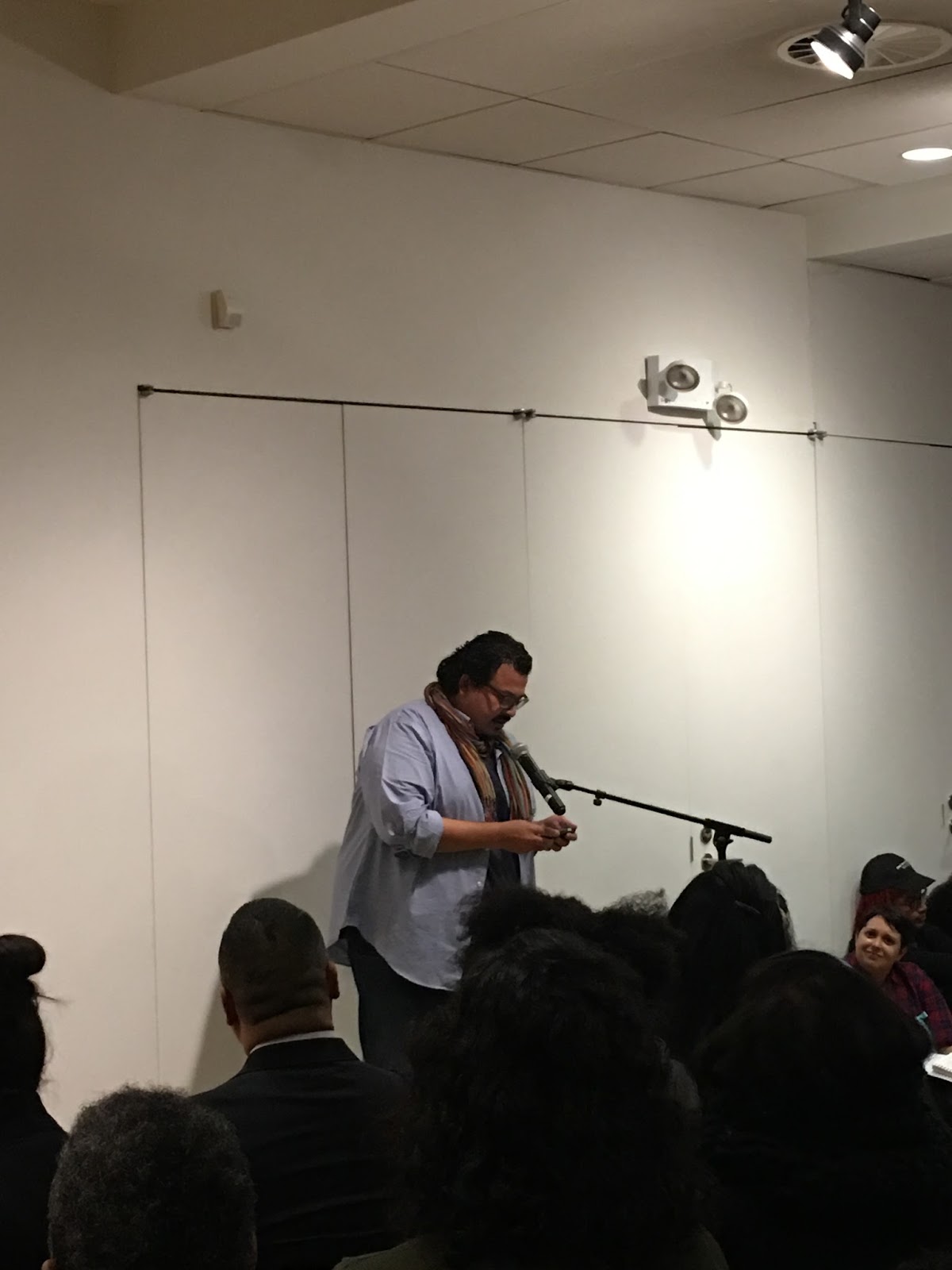
 Eduardo C. Corral

Eduardo C. Corral, the first Latino recipient of the Yale Series of Younger Poets prize, called González, “threshold and exit,” a means to entering and gathering within community but also a way out to practice talent and growth. Corral, who has extended his support and guidance to many young latinx poets, including myself, lovingly called González his mentor and brother. 
Vickie Vértiz

Vickie Vértiz, author of the poetry collection Swallows, read an excerpt of González’s memoir Butterfly Boy: Memories of a Chicano Mariposa: “I look back at her defiantly, but then my aunt turns away and keeps collecting clothes as if she hasn’t seen two young men scrubbing heat out of their flesh ... “I think we should go in, you,” he says, placing his arm over his face for protection. He has broken the illusion. He has expressed weakness. I roll over on my back, shut my eyes, and spread my arms out. The rain continues to pin me to the roof.”  Vértiz explains that this “looking back defiantly” captures Rigoberto’s temperament. His commitment to queer communities and narratives is bold and unapologetic.
Juan Felipe Herrera

The evenings final reader was United States Poet Laureate, Juan Felipe Herrera. He read González’s poem the “The Solider of Mictlán,” and wooed the audience into a call and response song he accompanied with his harmonica.  Its refrain, “more books, more books” came from when Herrera asked González what he had in store for the future. Despite the distress of the recent election, Herrera urged us to continue to seek out magic, in González’s poetry and in his message of fortifying friendships and making love possible. “We all have things to do,” Herrera admitted, “but we chose this path.”

Rigoberto González takes the stage
When Rigoberto González stepped up to the lectern he was welcomed by a standing ovation.  If González had been overwhelmed by the affection, he showed no sign of it as he spoke with the clarity he had been celebrated for all evening. He talked of how although writing was a solitary act it did not have be lonely, how all our communities, including those supported by organizations like the Asian American Writers’ Workshop, Cave Canem, Kundiman and Canto Mundo, are and have always been intimately interconnected. Any gains or setbacks were all of ours to share. He explained how protesting with the United Farm Workers taught him at a young age that there was no waiting for anyone else to lift the weight of progress. González addressed the literary community at large, reminding us that it still held many of its doors shut to writers who didn’t fit the white heterosexual male description and how there was still much work to be done. Yet he expressed, in his defiant optimism, that change was coming, “this isn’t a threat, this is a certainty.” 

***

Nathan Xavier Osorio is the son of Mexican and Nicaraguan immigrants. He is from Sylmar, California and teaches translation studies at Barnard College. His chapbook The Last Town Before the Mojave was a finalist for the 2016 Atlas Review Chapbook Contest. His poetry and translations have been featured in Mexico City Lit, diSONARE and The Offing.  

Monday, August 24, 2009

Voices from VONA: E-interview with Vickie Vértiz

Every summer the Voices of Our Nations Arts Foundation (VONA) brings renowned writers from around the country to the University of San Francisco to nurture developing writers of color. In the first of a multi-part interview, VONA writing fellows Oscar Bermeo and Vickie Vértiz talk about their experiences at the VONA Voices Writing Workshops.
Oscar Bermeo: It’s the post VONA week, what do you think you’re missing most about the VONA experience?


VONA fellow Vickie Vértiz
Vickie Vértiz: I am missing the room where I take writing risks into really dangerous places, imaginary or real, with trust, developed as a result of our faculty and colleagues creating a safe space. “Safe” meaning affirmative, encouraging, through honest, pointed critique. This is space that exists as a result of a shared experience, through a visceral understanding of what life is like for people of color in this country. At VONA we share an understanding that frequently, our art and writing is not valued and is dismissed in this country, but there we are. At VONA your voice is invaluable, precious, and ready to be primed to be at its most beautiful.

I miss my LGBTQ Narratives course with Thomas Glave. I found it incredibly useful as a multi-genre workshop. It focused on our nuanced understanding of a our various sexual-political cultures within our racial and ethnic cultures. It was very responsive of VONA to listen to its queer community and create a specialzed class. Thomas has an incredible contagious drive; all his students caught it in our time together. Thomas asked us to produce 30 pages of writing in a five-day workshop where we were already work shopping something else. There’s a lot of demand to produce work at VONA, which is always the case.

Thomas offered an additional faculty panel– where he was the only speaker–about publishing LGBTQ narratives. He shared with great candor, the mechanics and the individual steps to take while one is publishing a book; from making extra visits to untapped locations on book tours, through hand writing thank you notes to supportive individuals along the way. He showed us how to be proactive advocates of our writing.

That panel was really grounding for those of us who have stars our eyes about publishing and what it means to us and our communities. Are we the next Cherríe Moraga or Piñero? Only if we’re willing to tear our hearts out and hold it up to stage lights. These writers are our heroes, but as emerging artists, we may not know what it’s going take for us to get in to the world of writing, to stay in, and continue to grow in unanticipated directions.

OB: And you did your second week this year with?

VV: With Ana Castillo in the Artists’ Residency.

OB: And how was that?

VV: I would tell other Chicanas who are familiar with her work and they’d say, “Wow! Really?” I was very honored to be in her workshop, given the breadth of her writing, an evolution from the Chicano Movement into new genres.

I had gone to a reading of hers a year ago and was listening intensely because, again, as an emerging writer, I’m learning constantly about what it takes be that prolific in so many genres. I was star-struck by her commitment to writing, and am finding that to be a strong common trait among my favorite writers. Obios perhaps, but raza, it still needs to be said. I was intimidated at first, but Ana, as much as Ana is a chingona writer, she’s just as playful.
Ana and Thomas were incredibly encouraging and supportive of my work, just the way Cherríe, Ruth, and Willie are as well. I mean forget about publishing questions and all that. These are my writing, my socio-political heroes, telling me: “Your work is good.” And I’m sitting there, my five-year old inner Chicanita from Bell Gardens saying, “Really? My stories are important?” I mean it’s still that valuable and powerful to hear that. I haven’t heard that in my academic life very often.

OB: Where was the first place you heard about VONA? What attracted you to it? And what were your first expectations going into your first VONA classes?

VV: My friend Aida Salazar, who is also a poet and is now working on a memoir, told me about it. She already has an MFA and she was told by other writers that she didn’t have to do VONA because she already knew what she needed.

However, since then, a lot of the students at VONA have MFAs and all of them feel that it offers the opportunity to work with people who get their work, which their MFA programs did not offer. It’s not just for folks who do not have an MFA. It’s an unparalleled opportunity to connect with prestigious faculty who look like you.

My initial expectations were that some people would like my writing and some not, but I was going to work with some of my favorite writers.

On my first VONA experience, my classes included Cherríe Moraga teaching a tree-day playwriting residency. On the first day of our workshop, a fellow student shared really painful writing about his family, and he was really upset and crying because he felt Cherríe did not yield to acknowledge his suffering. To this Cherríe replied, and I paraphrase of course, “This whole room understands your suffering and what you’ve been through. We are here with you. But we don’t have time to stay in that suffering. What we are here to do in these three days it to make your work as striking and urgent as possible.” Who else can say that to a writer of color, but people who have been there, too? To start off with that kind of understanding about my experience as a woman of color in this country is exactly why I’m hooked on coming to VONA.