
Nefelibata: Interviews with Latina Writers
curated and conducted
by ire’ne lara silva
nefelibata
(n.) lit. "cloud walker"; one who lives in the
clouds of their own imagination, or one who does not obey the conventions of
society, literature, or art
Installment #1:
Natalia Treviño
ils: ire’ne lara silva
NT: Natalia Treviño

ils: There’s an interesting tension between the title of your book, Lavando la
Dirty Laundry, and the poems found in the book. The title makes me think first
of Ricky Martin’s “Livin’ la Vida Loca” and then it makes me think of “airing
dirty laundry” in public, the gossip, the looks, the rumors, and all the
scandal. And while there is plenty of gossip and rumors, what captures me is
the earnestness of this collection—its real desire to actually ‘do’ the
laundry…to wash, to make clean, to make useful, to care for family history, the
individuality of family members, and wounds both old and new. What was it that
drew you so powerfully to the metaphor and reality of 'washing'?
NT: You are asking me to come
clean about this title, a title that hurts me to the bone. The title is
literally about a family scandal that I discuss in the title poem. But the
metaphor I am attracted to is about the science of cleansing. In chemistry
class, I learned about the chemical function of soap, which I talk about in my
poem, “A Lesson of Elements.” The soap molecule is like a chain, and one end of
that chain wants to chemically bond with that which is insoluble in water:
grease, and grime. This part of the soap molecule accepts the oil (and is
accompanying dirt) and becomes complete when it is attached to it. There are so
many lessons in this embrace. What if we do this too? Accept our dirt? Then we
can move on right? The water loving end of the molecule, says, ‘Let’s go with
the rest of this water.’ Water likes itself, wants to form unions, puddles, and
leaves swiftly. I hope many of my poems are accepting the dirt, and leave a
clear, bare essence behind. When I do not face my own dirt, I get into trouble.
I become false, and the truth is that I will stink with hypocrisy.
ils: At the end of the first section, your concern/connection with Greek
mythology takes the foreground. At first, I was rather surprised by the abrupt
switch from family poems to Greek poems and back again. It wasn't until after
some thought that it occurred to me that this was actually the perfect
placement. It seems to me that as a girl your definitions of femininity, womanhood, family roles, etc. were being shaped by the women around you. And
while you were learning those things, you were exposed to Greek mythology and
that also shaped your ideas about womanhood. What is it about the stories of
Penelope, Aphrodite, etc. that so struck you then and continue to speak to you
now?
NT: The stories about Penelope and Aphrodite did not really resonate with
me until I was really examining marriage and relationships after my
divorce. I began to see literary
characters of all sorts in a much softer, more human light. Knowing facts about
their stories, I began to imagine their inner dialogues, the feelings of
separation Penelope must have felt, the arrogance Odysseus may have felt before
he left her, the feeling of rejection from Adonis Aphrodite must have felt, a
feeling that would be totally foreign to her as the goddess of love and beauty,
and I began to fictionalize these stories in short poems.
Feelings of loss,
rejection, and separation are universal and human feelings whether they are
about a grandmother on the other side of the border, a wife in South Texas, or
a literary mother in a book from the other side of the world. I am talking
about the inner lives of women through family and familiar characters, and
those characters are a part of our collective imaginations.
In movies, books,
and schools, children are exposed to Hera’s jealousy and Zeus’ lust long before
they understand those feelings within themselves. For many kids under ten, this
may be the first time they get to know someone else’s ‘dirty laundry,’ and is
it a wonder that so many claim a love for mythology before they start middle
school? It is their dirt attached to the dirt on the page, and reading about
dirt allows readers to start to heal, to begin to let go, to understand they
can flush it out of their system.
ils: From 'Tortilla Skins':
"Years after
'Buelito had died, you were a new kind of/ woman. Certain eyes. Laughing,
traveling, playing cards. Able to/ wake and say, no, to skip the simmering
heat of guisados and/ flame-burnt tortillas by the main noon meal. Bake
a cake instead,/ at night. Crochet and smoke at the same time. Speak up
around/the men. Accept a small glass of beer...Would you/ remarry, I ask. You
are quick to answer: Yes, it is ugly to live/ alone." I think this poem
speaks fundamentally to the ambivalence some women may feel in the space
between tradition and freedom. Each comes with its own costs and rewards—and is
powerfully associated with one’s identity. As a poet and a woman, how do you
see your voice negotiating that space?
NT: Imagine extending your arms fully, and at the end of one arm, you are
holding on to tradition. It is pulling at you with a mighty force, holding you
up, all of the safety and acceptance that comes along with it. At the end of
the other arm, you are holding on to freedom, and it is also holding you up,
all of the promise and possibilities for happiness that can come along with it.
Each force can pull your chest apart if the pull of each is too strong. And
many women feel torn right down the middle of their bodies. Do they marry or
stay single? Do they have children? Do they only date men?
When we are pulled
by opposing forces, what allows us to feel balanced? If I give in to one pull
or the other, I will lose balance and fall to that side. I think it takes
strength to acknowledge the pull of each, to understand the attraction to and
resistance of each. The only way I know to negotiate that space in life is to
acknowledge the power of both forces pulling on me and not let one or the other
fully win. By resisting the total victory of either, I can keep my balance.
There are traditions in my poems that I embrace—love and marriage, motherhood,
self-sacrifice, but these traditions do not go unexamined. There are freedoms I
embrace as well— to criticize unfair marriage and unfair love, to show the
mutilation of the self that occurs in motherhood, to give voice to silenced
women who get lost in the struggle.
ils: In “Translating Birth,” you write “My grandmother once told me,/todos
mis partos fueron bonitos/of her five births. In Spanish,/ the word for birth
is parto,/and being raised gringa,/ I had been translating words to English/ by
removing the o. It almost always worked:/banco, bank, santo, saint…/The Spanish
for born was nacer. There was no nace./ At least birth and born alliterated in
Texas./ Nacer and parto did not. I heard all of my partings were pretty./ Could
the language be that wise?/ The child parts. Departs? Departe de meant from
whom./ I saw the baby as a part that came from the mother.” In this poem, I see
the poet’s need to relate the two languages, to find the places where words
mean the same in both tongues, and also to find the places where translation is
its own poetry whether beautiful or not.
NT: I love how you see this poem and how you explain it. As a bilingual
child, I was constantly looking for a way to understand one language or the
other, and when there was a connection between the two, the world briefly made
sense. There was common ground between my quiet little house in suburban San
Antonio and my home country, all that is terrible, greasy, polluted, candied,
delicious, and loving that makes Mexico. There was common language that could
float in my imagination, where I could hold a conversation with myself, where
it was safe to say it or understand it incorrectly. And when a word had no
sister cognate in English or no brother root in Spanish, it was extra hard just
to remember what it meant. Every cognate was a rescue boat for me. It meant I
could speak and understand the world around me. Words like dog and perro were a
challenge. Cat and gato made me feel better, even if I was adjusting the sound
a little to make them twins.
Often the
translation is poetry because poetry at its best offers a brief moment of
enlightenment, and it is done through an illumination on an already known idea.
I can write a poem about a cat, but when I compare a cat to a difficult friend,
my reader will see those elements of the cat which align with my metaphor. My
son recently wrote a poem with the line, “life is just death stuck in some
traffic.” Woah. We are all stuck in the traffic on the way to death. He gave me
something new. And translations do this all the time. A friend of mine and I
were recently talking about Chinese characters and how we each learned the same
thing in two unrelated workshops, that the character for autumn is two symbols,
a tree and fire. This makes me see autumn in a whole new light. The trees are
red and gold, the colors of fire. I have always loved the smell of Halloween,
which is simply the smell of burning leaves.
I think many poets
embrace the ugly, the gristled stone within the walls of the heart, the
bleeding eyes that are cooked with the barbacoa. Sometimes there is too much
emphasis on the gore for the shock value it can bring. There needs to be a
reason that illuminates, that sheds light on the subject. The gristle on the
heart needs to be compared to a lover or a politician. The bleeding eyes to
Jesus. How often do we put Jesus in a taco and eat him alive, calling it border
security or the Iron Dome?
ils: One of the poems that most affected me was 'Graft Draft.' No, not
just affected me, I broke down crying in public and walked home with tears
streaming down my face—because I identify so strongly with that desire to
‘carry’ a loved one’s pain, even if only for a little while. In a very brief
space, this poem enacts a journey of healing—not the medical aspects but the
emotional and psychological aspects of living with an illness/disease and how
we, as humans, make peace with it and bring it into our daily lives. And yet in
this poem and others, you don’t shy away from the very real and physical
aspects of your husband’s melanoma. What did bringing these experiences into
poetry do for you?
NT: Those poems came very quickly and fluidly after we were past some
major stages and worries with his cancer. As Wordsworth says, so much poetry is
“emotion recollected in tranquility,” and as my mentor and friend Palmer Hall
once said to me, “It takes about ten years to write about it,
doesn’t it?” We carry what haunts us. Taking these things to the page was a form of healing, of giving the emotions their due place, out and exposed in a non-violent manner. I say non-violent because this poem is about ripping off my skin to give it to my husband, to protect him. It is a desperate poem about the desperate feelings we both had when we were in the worst stage of his cancer, the not knowing. The emotions we felt made us want to tear the walls down, made us want to kill or die, and just end the fear.
doesn’t it?” We carry what haunts us. Taking these things to the page was a form of healing, of giving the emotions their due place, out and exposed in a non-violent manner. I say non-violent because this poem is about ripping off my skin to give it to my husband, to protect him. It is a desperate poem about the desperate feelings we both had when we were in the worst stage of his cancer, the not knowing. The emotions we felt made us want to tear the walls down, made us want to kill or die, and just end the fear.
We dwelled in the
not knowing privately, with him not wanting to tell his family overseas in
Australia and London until he knew, and me not being able to tell mine here in
San Antonio until his family knew. My son was very young, and there was no
point in sharing it with him as it would only frighten him, making us feel more
desperate facing his questions within the sanctity and safety of our own home.
And dealing with the not knowing went on for a long time. First we did not know
what stage it was. Next we did not know if he would get chemo and surgery or
just surgery. And then there would be another surgery. Next, we did not know if
it had spread to the sentinel lymphs, and so we had to wait for yet another
surgery. Pressure, pressure, pressure. Fear, fear, fear, surgery on days off
with no one from his job knowing either, and we only had each other to turn to
for comfort and for release, and we were facing his mortality alone and
together. Doctors, nurses, and oncologists were very kind, but casual about all
prognoses: “It may go to the brain. Call if you feel ANYTHING weird, ANYTHING
hurt. It loves to travel to the eye. And the heart too, so call if you feel
ANYTHING strange.” The man feels strange every day. He was over fifty. Oh, and
surgery, in four weeks, or three, or, really, it felt like three hundred weeks.
Poetry allowed me to
use extreme language to recollect and understand my anguish, my fear, and my
sense of guilt. He moved here to marry me, and the Texan sun gave him cancer?
The poems flowed easily. It was as if I had put a tourniquet on the wound that
wanted to bleed, and in the poems, I bled freely.
ils: I am fascinated by the voice of Mary Magdalene towards the end of
this collection:
“Jesus, my love, you
didn’t have to do it/ that way, accept the thrush. Wings, flutter/ of beatings,
serrated beaks against your back./ We’d only but touched in good ways--/And
wife of yours I was,” and later, “Husband, that night, blankets/ I wanted to
give you. Your body open/ to the rain. My face—ready for pluck/ and the ants
gathered at my feet as you died./ Hundreds upon me before I knew, crawling/
curled like frightened dirt to my feet and legs.” There’s something passionate
and unrestrained about her voice, her emotions. I would love to hear more about
how this voice came to inhabit you, and to ask what it is about Mary Magdalene
that fascinates you so?
NT: Certain stories hit me hard. I think we are all built that way.
Around 2005, I heard the stories about Mary Magdalene being the wife of Jesus.
It was in the news because Dan Brown called it into question in The DaVinci
Code, and news about The Gospel of Mary emerged, as well as the
controversies regarding The Gospel of Thomas. I was floored. I looked into it, and I saw that the language used to defend the idea that Mary could have been the wife of Jesus had to do with Jesus kissing Mary on the blank. A hole is in this Gnostic document right where this word would be, but people presume it is the Coptic word for mouth, and there is language that Jesus loved Mary best.
controversies regarding The Gospel of Thomas. I was floored. I looked into it, and I saw that the language used to defend the idea that Mary could have been the wife of Jesus had to do with Jesus kissing Mary on the blank. A hole is in this Gnostic document right where this word would be, but people presume it is the Coptic word for mouth, and there is language that Jesus loved Mary best.
It is a longshot, a
very long shot to think that their marriage would have been deleted and
concealed in each of the gospels that are now accepted. I came to inhabit this
voice, first, as feminist rebellion against the idea in the Catholic church
that Jesus only chose men as disciples. That is the precise reason given why
women may not be priests. So many women’s lives could have changed, and they
could have had such a positive impact on the world as Catholicism came to rule
the West. Maybe.
And if this is true,
historically, that she had been his wife, that she may have borne him children,
I was even more angry. She would have to be the ultimate silenced woman,
silenced because Christianity has been so loud in the shaping of so many
cultures and countries. Her teachings, her history wiped out for centuries.
This text, which was used to carve out the destinies of so many people through
war, through Crusades, through unregulated global power, could have had the
voice of a woman in it, a voice of an intimate soul, perhaps a voice of reason.
Again, there is no
hard evidence that they were married, and it is all fiction in my book, even
blasphemous, but the possibilities stirred my imagination, and I wanted to know
what would she say about the last events of his life if she had been his wife
as well as his disciple.
ils: In this book, we see you, the poet, as witness, as myth-reader, as
grand-daughter, as daughter, as niece, and later, as mother and wife—we see you
always in relationship to someone or something else. I’m curious to learn more
about where you are—as poet/writer, as an immigrant, as a woman of color, as an
academic, as a feminist, as a Latina. What other stories are you still wanting
to tell?
NT: I am entering new spaces, collecting what I can learn about Mary for
my new poetry collection, not Mary Magdalene, but Mary Mary, the mother of the
big JC. I am doing this as a gentle way to finally grieve for my grandmother Socorro’s death and celebrating her life. There are many explorations in front
of me with this journey, and it has taken me over five years since her death
for me to begin. I think I am delaying grieving not just for her, but for
Mexico, all of its grittiness, and all of its beauty that I always accepted as
my home country. My grandmother’s death coincides with a great separation I
have now with Mexico.
When she died,
several important family traditions also ended. And her death came just before
the increase in violence in her home city of Monterrey, which kept me from my
frequent travels there, and so the grief over my loss became not only about
her, but for a connection to home.
By exploring Mary, I
am entering the spaces I once inhabited with my grandmother, a space of
unconditional love, motherhood, and endless storytelling. My grandmother
worshipped Mary every day for over an hour a day, and the stories about Mary
echo in apparition stories, in healing stories, in pilgrimage stories, and in
her being used for the purposes of colonization of Mexico via the apparition
story of the Virgen de Guadalupe and the Virgen de San Juan de los Lagos. I
want to create stories out of facts and learn more about the sacred. My dear
friend and mentor, Sandra Cisneros says writing is prayer, and I cannot agree
more with that.
I am also in the
final stages of completing my novel, La Cruzada. This is a story about a
teenager named Berta who leaves her three-year-old daughter to come live in San
Antonio as an indentured servant. She is a compilation of several women I have
known who have made this difficult choice, and who suffered greatly as a
result. I am moved by their silent suffering, their lack of education, and
their lack of options. Often, their only choice in Mexico is prostitution. They
have babies, and they want to keep their babies alive. They will do anything.
What teenager knows how a decision will impact her? I have been working on this
novel for over seven years, first as a short story, but it grew and grew. I
feel for the mothers, and I desperately want more people to understand their
position. When we understand their ‘dirty laundry,’ we might act more like
neighbors than enemies.
**

Born in Mexico City and raised in San
Antonio, Texas, Natalia Treviño is
the author of Lavando La Dirty Laundry,
(Mongrel Empire Press, 2014). She is an Associate Professor of Englishat
Northwest Vista College and a member of the Macondo Foundation. Natalia
completed her Master’s degree in English at The University of Texas, and her
MFA from The University of Nebraska at Omaha. Her poems have won the
Alfredo Moral de Cisneros Award, the Wendy Barker Creative Writing Award, the
Dorothy Sargent Rosenberg Poetry Prize, and the San Antonio Artist Foundation
Literary Prize. Her poems have appeared in several literary journals including Bordersenses, Borderlands, Texas Poetry
Review, Sugar House Review, burntdistrict, and Voices de la Luna. She has been anthologized as a poet, fiction,
and non-fiction writer, with fiction appearing in Curbstone Press’ Mirrors
Beneath the Earth,and essays inShifting Balance Sheets:Women’s Stories of
Naturalized Citizens and Complex Allegiances: Constellations of
Immigration. She is finishing her first novel, La Cruzada, a testimony of a teenage mother who leaves
her daughter and her home in Mexico to work in the United States in an
arrangement meant to last two years. Having experienced a bi-national
childhood, she hopes to raise understanding between people on both sides of the
Mexican-American border. She
lives with her husband and son just outside
of San Antonio. Website: nataliatrevino.com
*
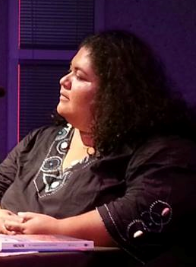
ire’ne
lara silva lives in Austin,
TX, and is the author of furia (poetry, Mouthfeel Press,
2010) which received an Honorable Mention
for the 2011 International Latino Book Award and flesh to bone (short stories,
Aunt Lute Books, 2013) which won the 2013 Premio Aztlan, placed 2nd for the
2014 NACCS Tejas Foco Award for Fiction, and was a finalist for Foreward
Review’s Book of the Year Award in Multicultural Fiction. ire’ne is the
recipient of the 2014 Alredo Cisneros del Moral Award, the Fiction Finalist for
AROHO’s 2013 Gift of Freedom Award, and the 2008 recipient of the Gloria
Anzaldua Milagro Award, as well as a Macondo Workshop member and
CantoMundo Inaugural Fellow. She and Moises S. L. Lara are currently
co-coordinators for the Flor De Nopal Literary Festival.

