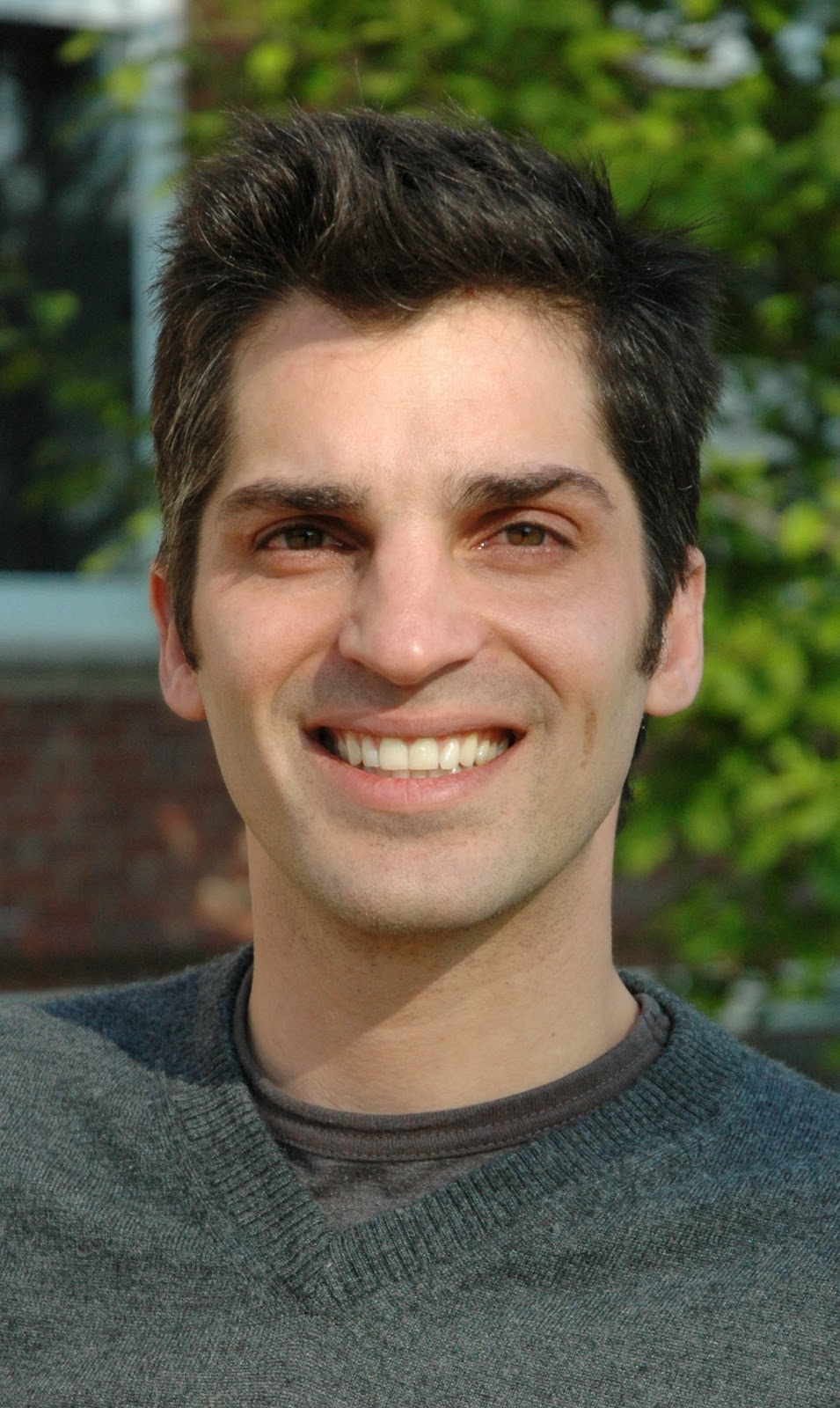
Blas Falconer
Commissioning prose on Latino writing (reviews, interviews,
etc)—is a big part of what we do here at Letras
Latinas Blog. We got a big boost when Lauro Vazquez joined the team
over two years ago, and another this past summer with Lynda Letona on board. That is:
both of these Notre Dame MFA-ers stepped to the plate to create/facilitate content. Facebook has also helped: I “met” Sebastian H.
Paramo through the Letras Latinas Writers Initiative (a FB group for
those Latino/a writers who are currently enrolled in, or have completed, a
graduate creative writing degree). Sebastian was invited/added to the group by one of the Initiative’s earliest members, Javier Zamora
(currently an MFA candidate at NYU). Long story short: I asked Sebastian one evening, on Facebook, if he'd be interested in carrying out an
interview for us. Here is the result. Our heartfelt thanks to him as we present this
thoughtful exchange, anticipating the final installment of Latino/a Poetry Now, at which Blas Falconer will be one of the featured poets. —FA

*
Sebastian
H. Paramo: The title
of your collection I found to be an interesting choice which also embodies the
choice to become a parent. Talk about the inspiration and how it felt right to
use this as a title. I found it very interesting that this sort of thing still
happens today with the foundling wheel, except that it's called a "baby
hatch," according to Wikipedia.
Blas Falconer: When
Joseph and I adopted our son in 2008, I became the primary care giver of a
newborn, so when I wasn’t working, I was with him. A fairly common experience
for parents, I had little time for anything else, and the limitations that were
placed on my writing shaped the writing itself. Instead of spending an afternoon
working on a draft of a poem, I only had time to jot down brief impressions. Writing
came in short and infrequent bursts, 20 or 30 minutes long, while the baby napped,
and when I probably should have been grading or cleaning up. I had a notebook
full of images, files full of “starts.” I needed something to ground the work,
an image that functioned as a touchstone, in my mind, at least, and the
foundling wheel served that purpose well.
I first learned about foundling
wheels from a story on NPR. It was the origin of the medieval device that piqued
my interest:
“The first foundling wheel, a
rotating platform, dates from 1198. It was installed in the wall of Santo Spirito
Hospital near the Vatican on orders from Pope Innocent III. He’d been dismayed
by the number of newborns found caught in the nets of fishermen on the Tiber
River.”
The image of the foundling wheel and
its history captured what was central to the book—the adoption, of course, and what
was at stake for everyone involved. In this “scene,” all the major figures
could be located on one side of the wall or the other, and the emotionally and
legally complicated process of adoption in the modern world could be suggested
in one imagined moment, in that turn of the wheel. With this as my foundation,
I was finally able to begin pulling the impressions together and write the
title poem.
Once a solid draft of the title poem
was written, I could move back and forth as if on a timeline to consider the lives
before and after, for example, the moment one realizes that he wants to have a
child (“Annunciation”) or what it might be like telling the child, a toddler
now, about his mother (“You Will Like It Here”). I could consider a
birthmother’s hesitation (“Another Point of View”), the impact parenthood has
on the relationship (“Maybe I’m Not Here at All”), consider my own childhood
(“Passing”), my own parents (“Another Kind of Music”).
Because of the time restraints on my writing, I
didn’t finish one poem and then start on the next. I was always drafting and
revising several at the same time, so they seem more deeply connected than the
poems from my first book, often alluding to each other and back to the image of
the foundling wheel, the act of its turning or its tragic origins.
There are other reasons why the title
resonated for me, but they are less obvious. The fact that the wheel turned,
that this child was quickly transported between two distinct worlds, two distinct
lives, made me think an awful lot about the poetic turn, how it can be abrupt,
shocking, disorienting. Becoming a parent felt like that, too, and so it seemed
an invitation to be more daring than I had been in my first book when it came
to turns. The manner in which the work was written—in fragments—leant itself to
this.
The wheel also made me think of the
cyclical nature of parenthood, what’s passed on to a child—genetically, yes,
but also habits, gestures, perspectives. Becoming a father, I couldn’t help but
see my own parents differently, their sacrifices. I also saw how much like them
I had become. Who influenced them, I wondered, considering the long lineage on
either side, and how do those people live still in my own behavior, now? How
will my own children be shaped by me, by my history?
Ultimately, I see this narrative and
these themes circling this one event, the adoption, and the image of the
foundling wheel created the gravitational pull to keep them in orbit.
Sebastian
H. Paramo: Many of your
poems sort of deal with the presence and absence of child/hood. "Another
Kind of Music" seems to embody this, as do some of your other poems. I
loved that not only did you bring in your new fatherhood here, but examined
your own relationship with your father/childhood with new eyes. Could you talk
a little about including this poem and the process? Since it's your longest
poem, I wonder because I usually associate long poems with taking longer times
to conceive.
Blas Falconer: The book’s
arc begins with the realization that a recurring speaker wants to be a father
and ends with the couple and the child together in their home, but this story
is interrupted by poems that consider his own childhood, how his own parents
struggled to understand each other, and what he, as he grew older, thought that he wanted. “Another Kind of Music,” a prose poem
sequence, comes at the middle of the book and addresses many of these issues.
In section one, the speaker acknowledges his homosexuality and
his inability to communicate that with anyone. His father knows that something
is troubling the boy, but the boy doesn’t think that the father will
understand. The second section captures the family, the sister practicing the
piano dutifully, the mother sitting still, but there is a sense that everything
is going to fall apart, the mother is eventually going to leave. The third
section juxtaposes the son’s sense of wonder with the father’s practical
sensibility. Their inability to understand each other is made very clear. In
section four, the speaker’s desires are growing, and he begins to better
understand who he is. In section five, we see the speaker, a young gymnast and
his coach. The speaker has fallen in love with the coach, who seems oblivious.
The speaker’s heartbreak is told through a moment in which the coach fails to
spot the young man as he attempts a new and seemingly dangerous acrobatic move.
In six, the young man is with a young woman, and it is his first kiss. In that
moment, he makes the decision to kiss her back, if only to avoid confronting his
homosexuality or facing heartbreak again. One kiss leads to another, and he
becomes the mother, dreaming of a different life.
I wrote the sequence over a long period of time. At first, I
didn’t know if it was a poem or a memoir. All I knew was that, in this prose form,
I felt free to explore a different syntax (or music) and that I was able to
better inhabit the moment that I was trying to recreate. It was as though I
were being lowered into a memory, into a younger self. In this space, I felt
free to be more open-ended, to leap unapologetically, because I was talking to
myself, my adult self, about what had happened to draw parallels with my
parents’ relationship, to suggest that, among other things, when communication
breaks down between two intimates, it is just another kind of “passing.”
Sebastian
H. Paramo: In some
of these poems, I found there to be a sense of loss/absence that echoes from
your title poem throughout. Particularly, in "Attic," "Maybe I'm
Not Here at All," and "Vertigo" to some degree. Could you talk
more about how that loss/absence figures into the putting together of this
collection.
Blas Falconer: Several
weeks after our son was born, Joseph’s father died. These poems and others
address his struggle to grasp his new role as a father while also processing
his father’s death. One of the main narrative threads in the book is the toll
that everything takes on the adopting parents and how tragedy and fear can make
strangers of two people who care about each other.
Toward the end of the book, the elegiac poems and poems about my
son’s febrile seizures lead to a more meditative mode on the subject of loss.
More specifically, the question posed by Mary in the poem “Annunciation”—To
have a child who suffers great pain? Certain death?—resurfaces, and the parents
wrestle with this fact.
Sebastian
H. Paramo: One thing I really enjoyed was that your poems
engaged with landscape and intersected with the metaphysical landscape.
Particularly in your preface and epilogue poems, it seems that they're very
much in conversation, by posing the initial uncertainty "/You'll
test/yourself the way you always have, a boy /stepping into the dark and the
story it held—whatever it was." and the closing poem offering reassurance
"Before long, we could skip a bar and reach each other faster, which is/
how you might tell a story." Could you talk a bit about your sequencing of
this conversation?
Blas Falconer: If the
book as a whole tells the story of this family, then the first poem, a
prologue, is a call to the muse, sitting outside of the narrative but expressing
the need to speak frankly. “To press the air, to bless the silhouette” is
written in loose heroic couplets with the title being the first line, but by
the end of the poem, the tight form falls apart to urge the poet to step into
the dark and the story it held, “whatever it was.”
The epilogue is a prose poem that reflects on a childhood friend
whose father had died, how I struggled and failed to talk about it with my
close friend, who I watched suffer tremendously, silently. In “How to Tell a
Story,” the two children cross the monkey bars back and forth, and the poem
points out that you can tell a story without telling every fact or detail in
the story. We can communicate with each other, perhaps more immediately and
more powerfully, with a few particular details and gestures, the way we could
cross the monkey bars faster by skipping rungs. The figures or characters in
this poem are in the body of the book, too, but by placing this poem at the
end, outside the narrative as an epilogue, I want to suggest that the book is
the story, the individual poems, bars. We skipped many, but I hope that the
ones that we’ve touched are enough to get you across.
Sebastian
H. Paramo: The ekphrastic
seems to come in a lot here with your poems "The Annunciation,"
"Still Life with Three Zinnia Elegans," "Look at You." Do
you have a background in art and could you tell us more about how it was useful
for this collection? I noticed you seemed to use the poem almost like a canvas
in your other poems such as "Still Life With Orange" and that the
image of the horse returns in "On Joy."
Blas Falconer: I don’t
have a background in the visual arts, but sometimes I like to think of the poems
that I’m writing as small films. I’m the director with his camera, zooming in
and out, so they are often image driven. I’m trying to render the image in such
a way that it mirrors the feeling or feelings that I hope to capture. Eliot’s objective
correlative and all that. With the ekphrastic poem, I can focus on an image
that isn’t mine, a pleasure in itself, and remain sensitive to the emotions or
ideas that rise up. When I studied Bruce Checefsky’s photograph of three
blurred blossoms, I felt something similar to the feeling that I had while watching
my son have his first seizure, his delicate body trembling fiercely. When I saw
Tulu Bayar’s prints of photographers, I began to wonder what they were looking
for. I thought of Joseph and his father’s death, how harsh the world seemed to
him, but also, that he couldn’t see that he
was still the source of great tenderness. The ekphrastic poem allowed me to
temporarily turn away from the story while still exploring the themes and emotions
that the story wrestled with.
Sebastian
H. Paramo: One
last thing, I really loved the way you played with the possibility in your
poems. They had a fairy-tale/mythic quality to them. I think it may have to do
with the way you somehow suddenly bring us into a moment and then bring us out.
I'm thinking of this particular example:
It begins with
a silver faucet, a salt shaker
on the window sill. I must go
if I want to take you with me.
You've lived here
longer than I've lived
anywhere. Think warm bread,
think fire. Then something more stable,
more lasting, a table or chair.
From there, it builds itself:
the walls, a roof, the world outside,
four dogs, and ten
acres of trees. It's cold.
Today, let's call it a farmhouse.
You say, Maybe a barn
painted red.
We build it together, which
is what I meant by Better.
Could you tell us more about this poem?
Blas Falconer: Frankly, becoming a parent for me seemed so unlikely, that
the subject matter may have leant itself to this mythic quality. Then, once we
miraculously became parents, we struggled to understand what that meant for us.
Throughout the book, there are references to adoption stories—Joseph and Mary,
for example, and Moses, of course—but these stories clearly wouldn’t serve as
models for our family. As can be seen in “Another Kind of Music,” my own
upbringing wouldn’t work either, so we had to imagine something new for
ourselves. This poem speaks directly to that desire to build our lives
together, less from where we’d come or what we knew, and more from what we
imagined was right for us, one image at a time. “Lighter,” the penultimate poem
in the book, shows the home built and a moment when the two parents work
together to care for their child.
*
Blas Falconer is an NEA fellow and
the author of two poetry collections: The Foundling Wheel (Four Way
Books 2012) and A Question of Gravity and Light (University of Arizona
Press 2007). His poems have been published in various literary journals and
featured by Poets and Writers, Poetry Daily, The Poetry
Foundation, and Poetry Society of America. A coeditor of The
Other Latino: Writing Against a Singular Identity (University of Arizona
Press 2011) and Mentor and Muse: Essays from Poets to Poets (Southern
Illinois University Press 2010), he teaches at the University of Southern
California and in the low-residency MFA at Murray State University.
****
Sebastian H. Paramo
Sebastian
H. Paramo is Texas native and has lived in Dallas, Milwaukee, and New York.
He received his BA from the University of North Texas & MFA from Sarah
Lawrence College. He is an editor at the online journal, The Boiler and his work has appeared or is
forthcoming in Terminus, Canary, Lunch Ticket, The Oklahoma Review, Used
Furniture Review among others. He was recently awarded a residency at the
Vermont Studio Center. Currently, he lives in New York where he teaches college
writing at College of Mount Saint Vincent.